
Burning Land-Clearing Debris in Moore County, NC
Burning land-clearing debris in Moore County, NC is allowed in the right place on the right day, but two sets of state rules stack on top of each other: the NC Forest Service burn permit, which protects the woods, and the state air quality rule for land-clearing fires, which protects neighbors and roads. Towns can add their own limits. This page sets out each rule as written, who to call, and the ways to handle debris without a fire. Checked October 2026.
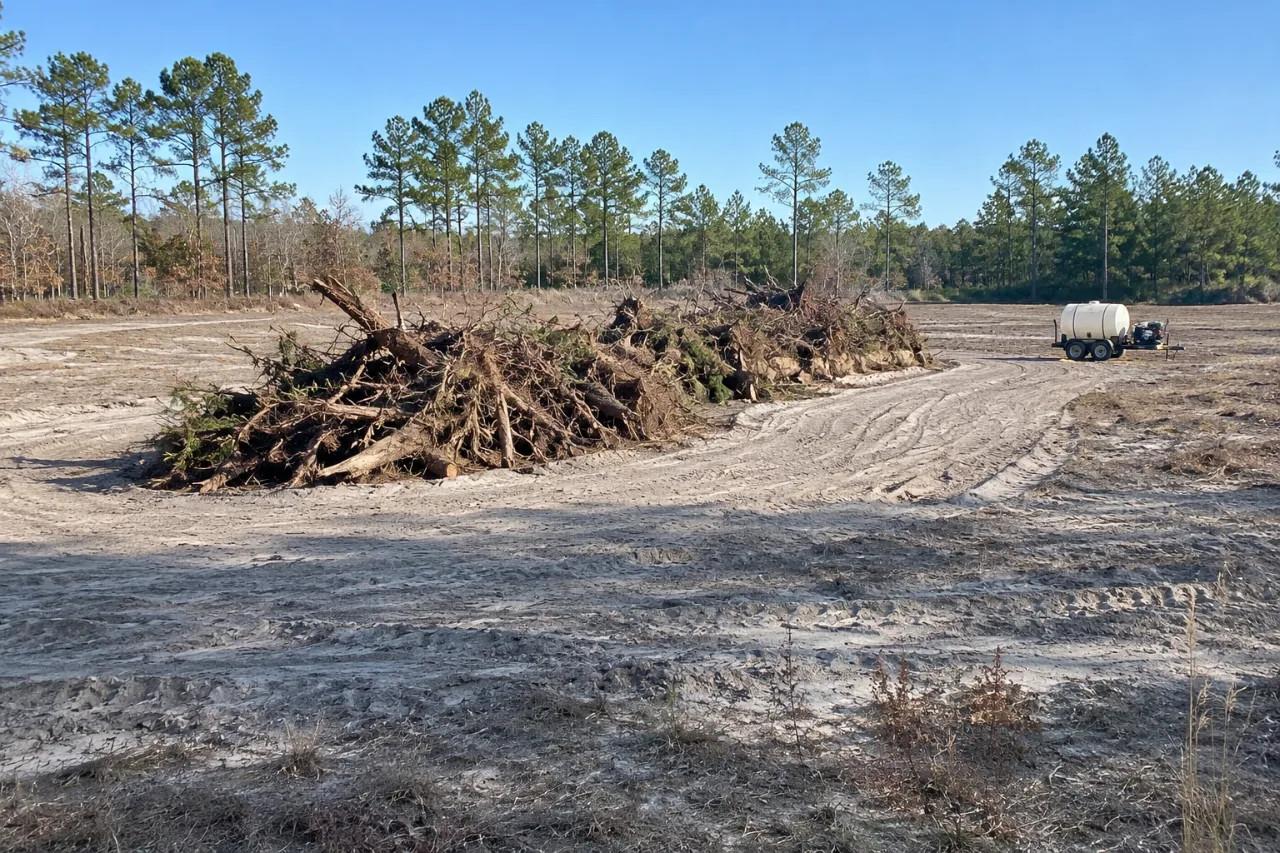
Rule one: the NC Forest Service permit
Moore County is not one of the "high hazard" counties listed in G.S. 106-942, which are mostly in the east and carry stricter burning rules. For counties like Moore, the NC Forest Service says a permit is required "between midnight and 4 p.m. for any open burn" in or within 500 feet of woodland that will take place "more than 100 feet from an occupied dwelling." Other points from the Forest Service page:
- "Burn permits don't cost anything." You can get one online at ncforestservice.gov/burnpermits, or in person at an NC Forest Service county office or a local burn permitting agent.
- Burn only during the time shown on the permit, and the permit "can be canceled if fire danger is too high."
- When the state issues a burn ban, open burning is prohibited "regardless of whether a permit is required."
- Burning debris from more than five acres takes a special permit with additional safety conditions.
The Moore County office of the NC Forest Service is at 1358 NC Hwy 73, West End (910-235-0216). Call before a big burn; the ranger can explain conditions and any special permit.
Rule two: the state air rule for land-clearing fires
Land-clearing burns also have to meet 15A NCAC 02D .1903(b)(2), the state's open burning rule (rule text from DEQ). In summary:
- 500 feet. The burn must be "at least 500 feet from any dwelling, group of dwellings, or commercial or institutional establishment," or other occupied structure, counting only buildings not on the property where the burning is done.
- Waivers. The DEQ regional office supervisor can make an exception when "a signed, written statement waiving objections" is submitted and approved before the fire. The rule does not allow a waiver when a school, college, day care or similar facility within 500 feet is occupied.
- Wind. The wind must blow away from any area that smoke or ash could affect, "including public roads within 250 feet of the burning," measured from the edge of the pavement.
- Hours. "Initial burning begins only between the hours of 8:00 a.m. and 6:00 p.m.," and nothing is added between 6 p.m. and 8 a.m. the next day.
- Only plant growth. No "heavy oils, items containing natural or synthetic rubber, synthetic materials," or anything else that isn't land-cleared vegetation. Kerosene, distillate oil or diesel may be used to start it.
- Stays on site. Debris can't be carried off the property or over public roads to be burned, except to a permitted air curtain incinerator or another qualifying location.
- Air quality days. No burn may be started in a county forecast to be in an Air Quality Action Day Code Orange or worse.
Questions about waivers and the air rule go to DEQ's Fayetteville Regional Office, 225 Green Street, Suite 714, Fayetteville (910-433-3300).
What the 500-foot rule means on a real lot
Five hundred feet is a long way. On a lot with houses on several sides, as on many in-town and subdivision lots, there is often no spot that far from every neighbor, and collecting signed waivers from each one is a project of its own. Burning tends to be realistic only on larger rural tracts where the pile can sit far from any home and away from roads. Even then, the woods around the pile and the weather decide whether the Forest Service permit is issued for that day.
Inside town limits
Towns can set their own rules on open burning. Before planning a fire inside Southern Pines, Pinehurst or another town, ask the town. Southern Pines Planning (910-692-4003) and Pinehurst Planning & Inspections (910-295-1900) can point you to the right department.
Prescribed burning is a different job
A prescribed burn in the woods, done to manage longleaf pine and the plants under it, is forest management, not debris disposal. It still needs the Forest Service permit during permit hours. The federal 4(d) rule for the red-cockaded woodpecker excepts take caused by prescribed burns on private land when landowners follow best management practices, and NRCS EQIP practices for forest landowners include "prescribed burning." See scrub oak and understory clearing and the woodpecker rules.
Ways to skip the burn pile
- Mulch it standing. A forestry mulcher grinds brush and small trees where they grow, so there is no pile at all.
- Grind the pile. A large grinder turns stacked debris into chips that can be spread on lanes or hauled away.
- Haul it. Logs, tops and stumps can be trucked to a facility that takes land-clearing debris. Ask the contractor where they take it and whether disposal is in the price.
- Sell the timber first. On a larger tract, merchantable pine may be worth selling before clearing, which leaves less to deal with afterward. A consulting forester can help.
- Air curtain incinerator. The air rule names permitted air curtain incinerators as a place debris can go.
Burning questions
Who gets the burn permit, the contractor or the landowner?
Settle it in the contract: who obtains the Forest Service permit, who watches the fire, and who is responsible if it escapes. Ask the Moore County office (910-235-0216) if you are unsure whose name belongs on it.
Is burning allowed on a Code Orange day?
No land-clearing burn may be started in a county forecast to be in an Air Quality Action Day Code Orange or above.
Can debris from another property be brought in and burned?
Not under the land-clearing rule. Debris can't be moved off site or over public roads for open burning, except to a permitted air curtain incinerator or other qualifying location.
How close to a road can the pile be?
The rule doesn't set a fixed distance from roads, but the wind must carry smoke away from public roads within 250 feet of the fire when it is lit. A pile near a road narrows the days that work.
How the referral works
Phone or use the short form to say where the property is, the rough size of the area and the work you have in mind. A single independent contractor who covers Moore County gets the request, visits to see the land in person, and puts a price in writing. Going ahead is up to you, and landowners pay nothing for the referral.
Want one local contractor to look at your land?
Phone or fill in a short form. The referral is free to landowners.