
Forestry Mulching in Southern Pines, NC
Forestry mulching grinds standing scrub, briars and small trees into a layer of chips with a single tracked machine, so nothing gets piled, hauled or burned. Around Southern Pines and the rest of Moore County, NC, that fits a lot of what Sandhills landowners want done: thinning turkey oak and blackjack oak under longleaf pine, opening a wooded lot to see it, cutting trails, and clearing fence lines. Here is how it works, where it suits Sandhills ground and where it doesn't, what national cost guides say it costs, and which rules still apply.
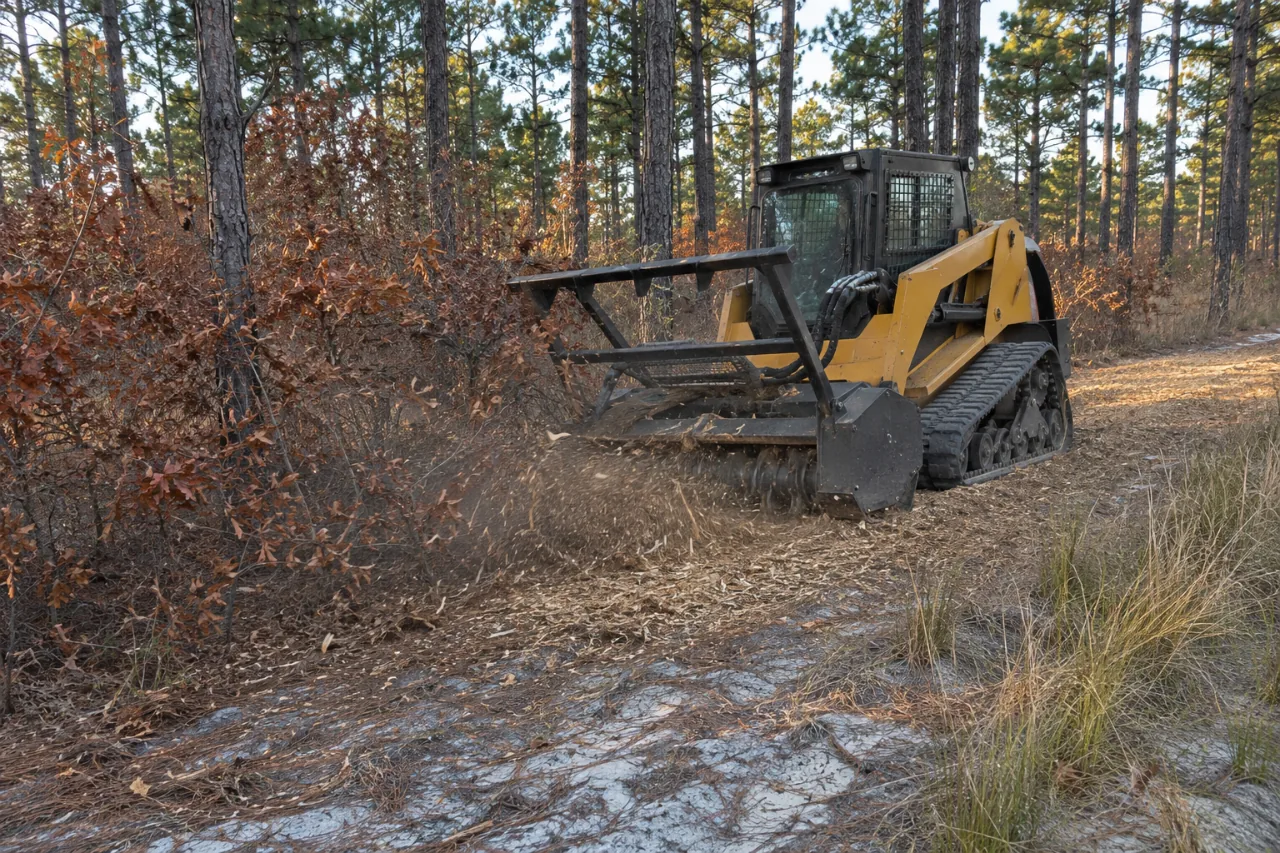
How a mulcher works
The business end is a heavy drum or disc fitted with hardened teeth. It rides on a compact track loader, a skid-steer, the arm of an excavator, or a purpose-built tracked carrier. The operator pushes the spinning head into standing growth and it chews the stems down from the top, dropping chips where they fall. One person runs one machine; there is no ground crew cutting ahead, and no trucks carrying brush away.
Heads vary a lot in what they can handle. Ask each contractor what stem size their machine takes comfortably and what happens with anything bigger: whether they fell it and grind the pieces, leave it, or switch to a saw and an excavator. That answer tells you whether a quote is for mulching alone or for a mix of methods.
Why it fits Sandhills land
- No burn pile. Burning land-clearing debris in Moore County runs into an NC Forest Service permit for most daytime fires near woods and a state air rule that wants the fire at least 500 feet from any dwelling. Mulching leaves nothing to burn. (The burn rules in full.)
- It's selective. An operator can thin around the pines you want and leave chosen oaks, dogwoods and hickories. USDA lists blackjack oak, turkey oak, bluejack oak, post oak and longleaf pine as the trees on wooded Candor soils, the deep Sandhills sands (Candor series description). Mulching lets you pick which of those stay.
- The ground stays put. Stumps are cut low and the roots remain, so the sand isn't churned up or left full of holes.
- Pine straw. The same USDA description notes that on these soils longleaf "needles are commonly harvested." If you rake straw or lease it, mark those areas so the operator can keep chips thin there.
Typical mulching jobs in Moore County
- Taking out the scrub oak layer under longleaf so you can see and walk the woods. See scrub oak and understory clearing.
- Opening a wooded lot before deciding where the house goes, then grubbing only the footprint later.
- Fence lines and pasture edges on horse farms. See horse farm and pasture clearing.
- Trails, riding lanes, hunting lanes, and fire lines around woods you plan to burn.
- Clearing back from a house, barn or shed so the woods no longer crowd it.
- Opening a view across a slope or down to a pond, within whatever buffer applies near the water.
When mulching is the wrong tool
- Under a future slab, drive or drainfield. Buried roots decay and the ground over them sinks, so in those spots the stumps have to be dug out. See lot clearing.
- Big pines. Mature pines generally call for a saw, not a mulching head, and cutting them can bring the woodpecker rules into play (below). Some may be worth selling as timber first.
- Close to a stream or pond. State law requires a buffer along lakes and natural watercourses during land-disturbing work. Ask before mulching down to the bank.
- When you need bare soil now. Grass seed struggles under a deep chip layer until it is raked thin or breaks down.
The woodpecker check
Even a mulching job can touch the federal red-cockaded woodpecker rules. The U.S. Fish and Wildlife Service's Clear Zone self-certification letter for Moore County says the project must not take place within 50 feet of a woodpecker cavity tree, and it recommends avoiding the removal of large pines and keeping all old-growth longleaf. In the Red Zone, a site plan of every pine to be removed or affected is part of the review package, and one item on the Service's form asks whether trees 8 inches in diameter or larger will be removed. The woodpecker rules page explains the map and both letters.
Regrowth
A mulcher cuts hardwoods off at the ground; it doesn't kill their roots. Ask the contractor what regrowth to expect from the oaks and other hardwoods on your land and what the follow-up plan is: a second pass, mowing, prescribed fire, herbicide, or a mix. For woodpecker habitat, the Service lists prescribed fire and hardwood midstory control among the management work Safe Harbor landowners take on, so a regrowth plan and a habitat plan can be the same plan.
What forestry mulching costs
HomeAdvisor's forestry mulching cost guide (checked October 2026) says most homeowners can expect to pay "between $400 and $1,500 per acre," with a national average of $500 an acre, and that hourly rates of $125 to $400 are charged for small, compact areas. Those are national figures. On Moore County land the price moves with how thick the scrub is, how big the stems run, how many pines and other trees the operator has to work around, slopes, travel and minimum charges, and whether any grubbing or hauling is mixed in. What you actually pay comes from the written price of a contractor who has been on the property. More in the cost guide.
Permits for mulching
Three things to check before a large job:
- The one-acre erosion line. The state requires a plan before disturbing more than an acre. Whether mulching that leaves the roots in the ground counts toward that acre is a question for DEQ's Fayetteville Regional Office (910-433-3300); ask before a large job starts. Inside Southern Pines, ask the town, which runs its own erosion program.
- Town rules. Southern Pines' ordinance bars clearing before an engineering plan, land disturbance permit or building permit approval, and a house lot of 30,000 square feet or less needs an Erosion Compliance Permit instead. Pinehurst lists land-disturbing activity, including clearing, among the work that needs a permit. Details in the permits guide.
- The woodpecker map, as above.
Forestry mulching questions
How deep will the chips be?
That depends on how much is growing. A light stand of scrub leaves a thin layer that settles quickly; a dense thicket leaves more. Ask the contractor to describe what the ground will look like afterward, and whether they spread heavy spots.
Can the operator leave the longleaf and the biggest oaks?
Yes, that is one of the main reasons to mulch. Mark every keeper before the machine arrives and agree on how close the head may work to each trunk.
How long does an acre of scrub oak take?
It depends on density far more than on acreage. Ask for an estimate in machine hours along with the per-acre price, so two quotes can be compared.
Is mulching allowed near a woodpecker cavity tree?
Under the Service's Clear Zone letter, no work is allowed within 50 feet of a cavity tree. In the Red Zone, the Service reviews the project first. Call the Service's Raleigh office at (919) 856-4520 with questions.
How the referral works
Phone or use the short form to say where the property is, the rough size of the area and the work you have in mind. A single independent contractor who covers Moore County gets the request, visits to see the land in person, and puts a price in writing. Going ahead is up to you, and landowners pay nothing for the referral.
Want one local contractor to look at your land?
Phone or fill in a short form. The referral is free to landowners.